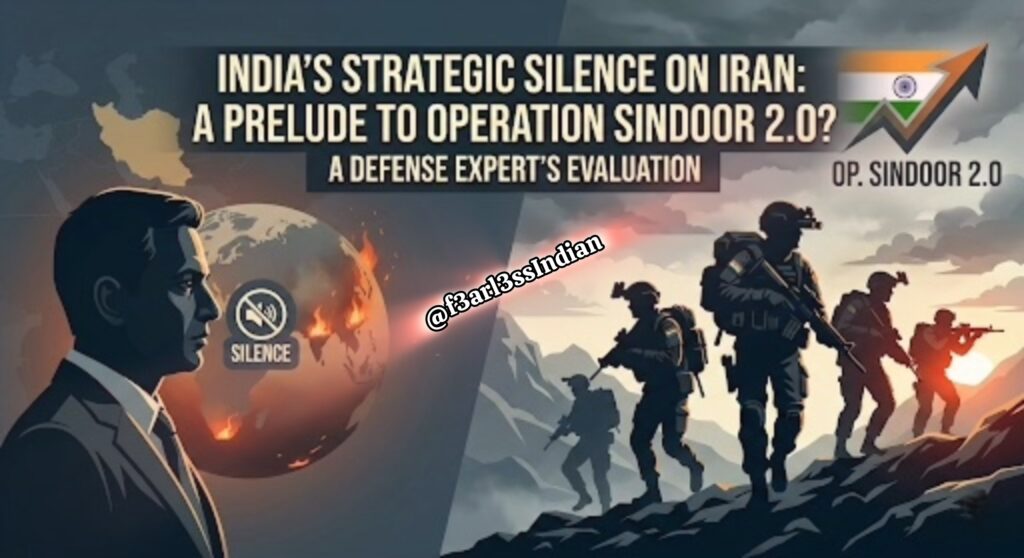
The geopolitical landscape is convulsing. Following the massive, unprecedented US-Israeli kinetic strikes on Iranian nuclear and military infrastructure on March 1, 2026, the world is holding its breath. Every major power has issued a definitive statement—except one.
New Delhi’s calculated silence is deafening.
While official MEA channels have offered the standard platitudes of “grave anxiety” and calls for “restraint by all sides,” India has conspicuously refused to join the Western chorus condemning the unilateral strikes. This isn’t diplomatic inertia; it is a profound signal.
As defense analysts, we must interpret this silence not as passivity, but as a strategic maneuver. My assessment is that India is simultaneously normalizing a new international doctrine of defensive pre-emption and accelerating its own contingency plans for a decisive theater operation on its western border: Operation Sindoor 2.0.
The Iran Precedent: India Holding Up the Mirror
The theory gaining significant traction in strategic circles is that India is intentionally allowing the US and Israel to set the “precedent” it intends to exploit. By failing to criticize the unilateral action against Iran, India is effectively holding up a mirror to the international community.
The implicit message is clear: If the West accepts that the US and Israel have a unilateral right to eliminate existential threats in foreign sovereign territory, then India claims that exact same right regarding terror hubs on its periphery.
This marks the definitive pivot of India’s “National Interest First” doctrine. The old paradigms of Non-Alignment are discarded. We are now witnessing a policy of “Multi-Aligned Autonomy.” By ignoring Western pressure to join their coalition, India is ensuring that when it decides to act against threats from Pakistan-occupied Kashmir (PoK) or beyond, it cannot be accused of hypocrisy.
New Delhi has successfully created a strategic buffer zone. It will ignore Western actions in the Middle East, so long as the West, distracted by the chaos it created, ignores India’s necessary actions closer to home.
Inside Operation Sindoor 2.0: The Strategic Timetable
The historic precedence of Operation Sindoor 1.0 (May 2025), which targeted nine distinct launchpads, reshaped India’s retaliatory framework. However, statements emanating from the Army’s Western Command in late February 2026 confirm that Operation Sindoor 2.0 is not merely a theoretical exercise, it is active.
While specific operational details are classified, the indicators of imminent action are undeniable. Based on intelligence briefings, logistical shifts, and past adversary behavior patterns, we can map the factors pointing toward a potential kinetic event in the April-May 2026 window.
Synthesized critical indicators:
The Probability Assessment
The critical question is: What are the chances?
My evaluation, based on an aggregate analysis of military positioning, weather data, and political signaling, places the probability of a major Indian cross-border kinetic operation peaking in April–May 2026 at High (70-80%).
Three converging factors make this window the point of maximum probability:
The Anniversary Trigger: April 22, 2026, marks the first anniversary of the Pahalgam incident the casus belli for Operation Sindoor 1.0. Adveraries often attempt commemorative strikes. Intelligence indicates heightened preparations to repel and retaliate.
Tactical Weather: The traditional “melt season” in the high Himalayas makes terrain traversable for both infiltration groups and Indian counter-offensive armor. The military logic for operating during this period is sound.
The Global Chaos Distraction: This is the critical geopolitical factor. With the US and Israel deeply bogged down in a direct, escalating conflict with Iran, the traditional “global monitors” are incapacitated. The UN is paralyzed. The international community lacks the bandwidth to intervene, sanction, or stop a localized Indian operation. India recognizes this as a rare strategic window.
Conclusion: Preparing for the New Reality
The silence from South Block regarding Iran is tactical, not ethical. It is the sound of a regional superpower preparing to execute its own strategy while the rest of the world is looking elsewhere.
We must understand that Operation Sindoor 2.0, when it happens, will be different from the past. It is likely being designed as a sustained campaign, not a one-off surgical strike. We are shifting from managing terrorism to neutralizing the very infrastructure of infiltration.
The Ministry of Home Affairs’ recent alert to state governments on March 2, 2026, regarding potential internal instability is a direct indicator. The government is not just preparing the military for external action; they are preparing the nation for the inevitable backlash.
As a defense expert, my evaluation is straightforward: The silence on Iran is the strategic quiet before the necessary storm on India’s western flank. New Delhi has already shown the world the mirror. Soon, it will ask the world to watch.


